


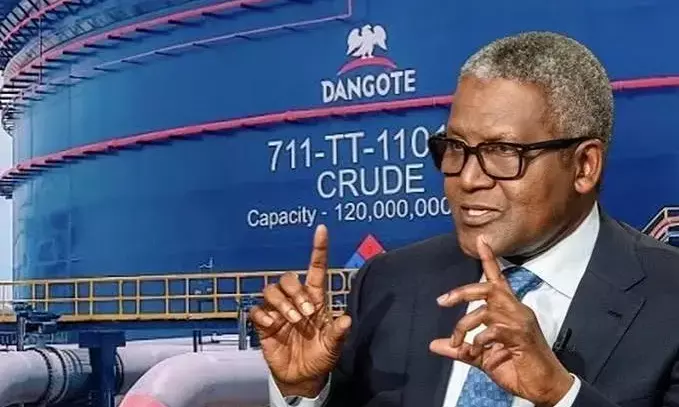
President of Dangote Group, Aliko Dangote, on Wednesday said there is an urgent need to address the estimated $7 billion debt owed by oil and gas operators to Nigerian banks.
This is as he cautioned that the huge financial exposure could undermine domestic financing for the industry and constrain efforts to increase crude oil production.
He opined that the Central Bank of Nigeria (CBN) and commercial banks should work together to restore confidence in the petroleum sector and unlock funding for operators.
He statedthat Nigerian banks should be able to provide more funding for indigenous oil and gas operators rather than leave them excessively dependent on foreign sources of capital.
He spoke on Wednesday as keynote speaker at the Executive Session of the 44th Annual International Conference and Exhibition of the Nigerian Association of Petroleum Explorationists (NAPE) in Lagos.
Dangote identified trust, transparency and good corporate governance as critical conditions for resolving the financing challenges and attracting fresh capital into the industry.
According to him, rebuilding confidence in the oil and gas sector will encourage financial institutions to reconsider their lending appetite, particularly as operators require substantial long-term funding to develop discovered fields, expand production and invest in new exploration activities.
He said Nigeria should accelerate investments in petrochemicals, adding that a $20 billion investment in the chemical industry could generate annual revenue of at least $30 billion, with a substantial proportion translating into profit.
According to hom, Nigeria’s economic transformation should not be anchored solely on crude oil production and refining but should extend to petrochemical manufacturing and other industrial activities capable of generating higher value from the country’s hydrocarbon resources.
He said: “If you invest $20 billion in the chemical industry, I can tell you, you can have a revenue of not less than $30 billion. And out of that $30 billion, most of it will be profit.”
Dangote decried that inconsistency in government policies is a major obstacle to investment.
He stated that investors require predictable regulations, political stability and confidence that policies announced by the government would be sustained.
He urged the government to move beyond announcing reforms and demonstrate consistency in their implementation, adding that investors needed assurance that projects would remain commercially viable throughout their lifespan.
Dangote questioned the adequacy of Nigeria’s target of producing three million barrels of crude oil per day, as according to him, it as insufficiently ambitious.
He recalled that Nigeria and the United Arab Emirates had previously set their sights on achieving production levels of 4.2 million barrels per day by 2024, asking why the country should now settle for a three-million-barrel target by 2030.
He stated that Nigeria must adopt more aggressive production targets and intensify exploration if it intends to compete effectively for international energy investments.
He said it is essential to have greater investment in local technical capabilities and advanced exploration technologies to improve geological understanding, reduce operational risks and support the discovery and development of new reserves.
According to him, Nigeria could not sustain production growth without continually replacing depleted reserves through exploration and the development of discovered resources.
He said reliable electricity, modern transport infrastructure, affordable long-term financing, strong local supply chains and a technically skilled workforce as essential requirements for industrialisation.
According to him, expanding domestic processing and manufacturing would not only create jobs and increase exports but also reduce dependence on imported industrial products, strengthen the naira and improve the country’s economic resilience.